Top 10 leadership development needs
What do 2,778 mentoring sessions reveal about the greatest challenges in leadership development today? I analysed real data from mentoring sessions conducted on the Upskill Platform over the last 3 months and it revealed that the topic most worked on by leaders with our mentors was not time management, nor communication, nor productivity.
- Analysis of 2,778 Upskill mentoring sessions over 3 months
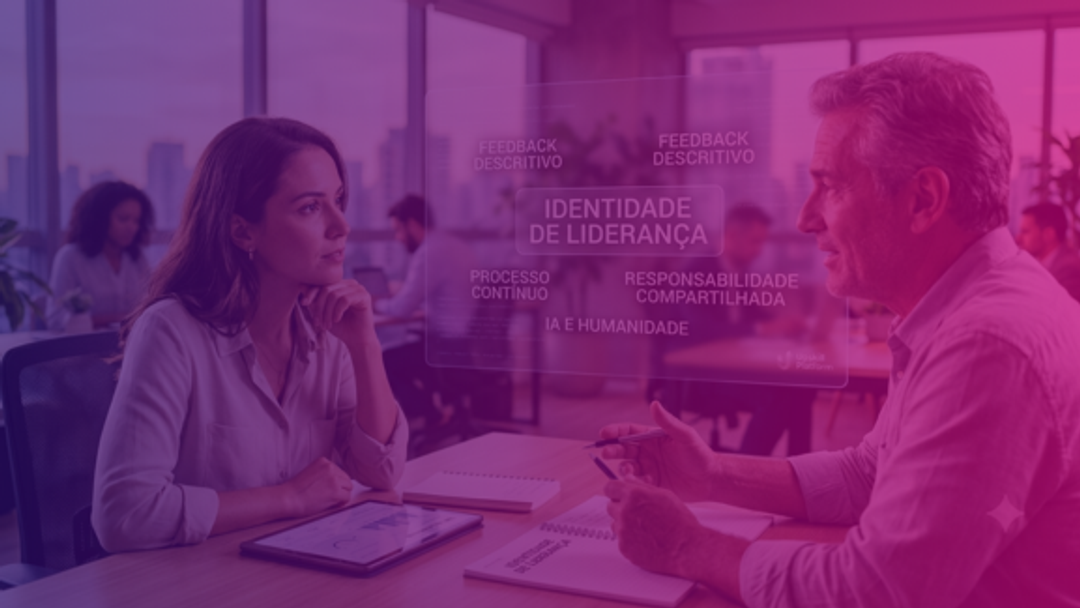
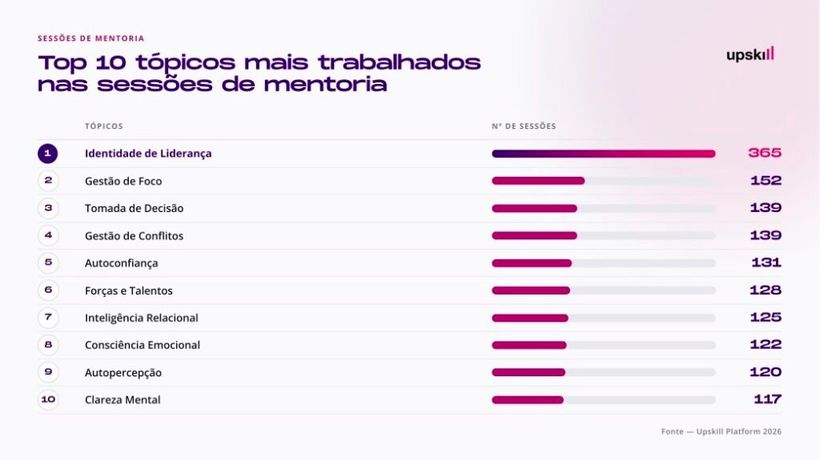
- Leadership identity was topic no. 1, with 365 mentions
- Why behaviour does not change on access to information alone
- Sensedia case: continuous development aligned with strategy
- The top 10 topics leaders work on most
- Measured results: +12% to +31% in the competency index
What do 2,778 mentoring sessions reveal about the greatest challenges in leadership development today?
I analysed real data from mentoring sessions conducted on the Upskill Platform over the last 3 months. It revealed that the topic most worked on by leaders with our mentors was not time management, nor communication, nor productivity.
It was leadership identity — with 365 mentions. Nearly double the second-place topic.
Why this matters
The importance of these findings lies in the fact that in the last two years we have all entered a sequence of transformations. And we are having difficulty seeing when these changes will cease or diminish.
- The meaning of work has changed. The space work occupies in people's lives has too.
- The contract between leaders and those they lead has changed. The generations that make up teams have completely different values, expectations and ways of engaging with each other.
- There is a mental health crisis. This impacts, year on year, engagement and performance.
- AI is arriving to challenge leaders' ability to be true agents of transformation, generating results without grinding down the health of teams.
- The leader who worked well 5 years ago — with the same style, the same frameworks, the same authority based on position — today finds themselves lost. Not for lack of will. For lack of support.
Behaviour does not change with access to information
Behavioural change, the maturation of a leader, happens through practice, reflection and continuous support in day-to-day work.
The problem is not that leaders do not want to develop. It is that the traditional model (which treats training as an event) does not generate behavioural change that positively impacts business performance.
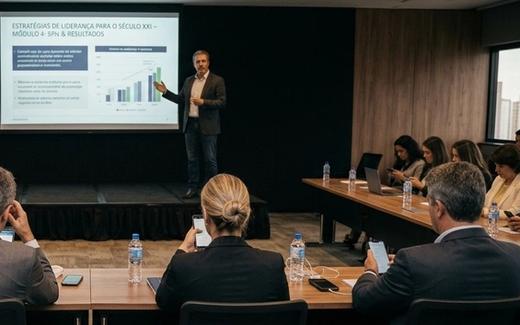
Sensedia, a Brazilian technology company, brought a great example of a shift in the paradigm about people development to HR4 Results in 2026. The proposal for change came from the need to align development with business strategy.
The critical changes to increase engagement and performance that Gabriela Atavila (People Strategy Teamleader) and Isaura Monteiro (Talent Management Specialist) shared at the event were grounded in three pillars (I hope I was faithful to what they said):
- They swapped assessment scales for descriptive feedback,
- In place of one-off development events, they created a continuous process,
- And both performance evaluation and competency assessment, as well as employee development, stopped being centralised responsibility at HR. Leaders began to share this responsibility.
What does leadership need to develop faster?
Sensedia applied the competency matrix to identify the most critical development needs. The goal was to make clear what competencies are missing for each employee/leader to advance in the pipeline.
Upskill's leadership mentoring programme has been a partner to companies in mapping leaders' competency gaps to offer a development model that accelerates the maturation of leadership.
The companies we work with today realised, just as Sensedia shared, that development without alignment with strategy is a waste of time and money.
Our clients also noticed that training cannot be one-off; it needs to be continuous. And it needs to truly contribute so that people have the opportunity to grow and thus drive business results.
On the Upskill platform's data dashboard, the programme manager (of the client's specific instance) can see, amongst other data, all the topics most worked on in sessions held with human mentors and with the virtualised mentor. This allows leaders and HR to see where the most critical points are for leadership maturation.
Below you can see a partial map of the most common development needs amongst the leaders we track. This is the top 10 of the most-addressed topics in recent months.
How have we contributed to accelerating leader maturation?
At Upskill Platform, we develop leaders through 1:1 mentoring with certified human mentors, continuously trained, as well as mentorIA, our virtualised mentor with artificial intelligence, available 24/7 to provide support between sessions.
Each leader starts with an assessment that maps their profile and gaps. The platform suggests personalised paths. Mentor Match selects the mentor with the most affinity. And progress is measured in real data.
In clients where we have sufficient data, we have seen growth of +12% to +31% in the leadership competency index — assessed by the leaders themselves, their managers and their teams.
See how Vivam Posterlli, CEO of Grupo Skill, views the translation of these numbers into daily work:
"By the end of the cycle, I noticed more integrated leadership in decisions, with greater capacity for listening, empathy and collaboration. For very technical leaderships, mentoring opened space to develop the more human side and strengthen emotional intelligence — something that made an enormous difference in atmosphere, in the maturity of discussions and in how we conducted our deliverables."
And for the HR Coordinator at EPH Incorporadora:
"Over the course of the process, leaders came to have greater clarity in their leadership role, better communication, more responsibility in decisions and greater maturity in team management."
If your leaders were mapped today, what would be the number-one topic they would bring to a mentoring session?
My bet: leadership identity would appear at the top as well.
Because the world has changed, and leading people has never been as complex and demanding as it is now. Moreover, changes are now even faster, requiring greater speed of adaptation.
If you want to understand how Upskill can help your company's leadership gain that maturity at the speed this moment demands, click here.
Mentors and specialists in leadership development, with more than 20 years of practice mentoring executives and entrepreneurs.