Psychosocial risks also affect leadership
We have the habit of saying that it is the responsibility of leadership to reduce and mitigate psychosocial risks for employees. However, who is responsible for reducing and mitigating psychosocial risks for leadership?

- Psychosocial risks reach the people who lead, too.
- Caring for the leader comes before demanding a healthy team.
- Stress and overload shrink the ability to see solutions.
- Self-awareness, resilience and composure are key competencies.
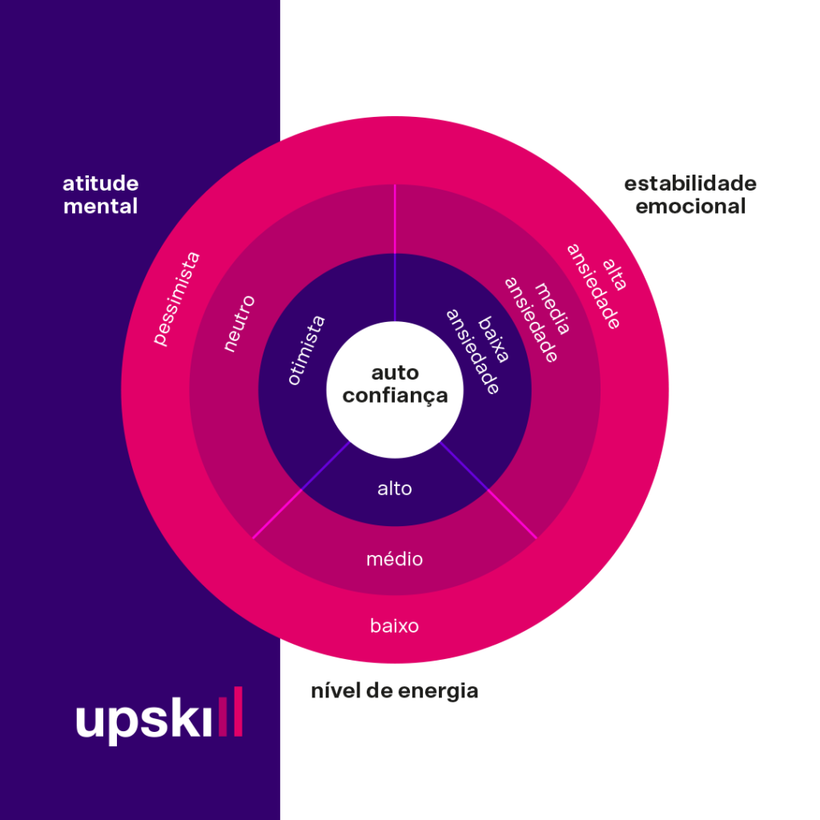
- The Self-Confidence Foundation framework measures anxiety and energy.
We have the habit of saying that it is the responsibility of leadership to reduce and mitigate psychosocial risks for employees. However, who is responsible for reducing and mitigating psychosocial risks for leadership?
In this article:
- What is: The article discusses how psychosocial risks also affect those who lead, not just employees. It argues that looking after the emotional health of the leader is a step prior to demanding they ensure the mental health of their team.
- Why it matters: In scenarios of constant market transition and change, overwhelmed and stressed leaders lose the ability to see solutions. As shown by the testimony of a leader in agribusiness served by Upskill, mentoring was crucial for her to recover her identity and return to inspiring her team during a year of market retraction.
- What to do: Develop in leadership self-awareness, self-confidence, resilience, interpersonal skills and growth mindset, learning to maintain serenity in the face of chaos. Use the Self-Confidence Foundation framework to measure anxiety, mental attitude and energy level, and support each team member to do the same.
Who looks after the emotional health of those who lead?
Faced with this question, perhaps we discover that leaders are the first ones who need support to minimise their own psychosocial risks. And this would be a step prior to holding them accountable for maintaining their team's mental health.
As was the case with a leader at an agribusiness company who participated in a Upskill mentoring programme during a year when there was retraction instead of growth in almost all market segments.
The real impact of mentoring on leadership
"Mentoring was crucial in helping me perceive solutions I couldn't see before due to stress and overload of demands […] The mentoring process helped me recover my identity and become a source of inspiration for my team, promoting positive changes in the work environment."
Mentoring accelerates necessary behavioural change
Cases like this reinforce the thesis that developing in leadership:
- self-awareness,
- self-confidence,
- resilience,
- interpersonal skills,
- optimistic and growth mindset.
…is the smartest way to prepare leaders to face moments of uncertainty, rapid market changes and changes in people's behaviour.
Courage, discomfort and growth
As Brené Brown states in the book 'The Courage to Be Imperfect':
"If someone is not uncomfortable in their position of leadership, it is almost certain they are not reaching their maximum potential as a leader."
Learning to be comfortable with discomfort is a great skill that can be trained.
It allows the leader to support their team in the face of uncertainty and fear of the unpredictable.
Serenity as a strategic competency
At the present time, almost all companies are in constant transition in some aspect, process or area.
Because of this, the leader needs to learn to maintain serenity in the face of the chaos of change and stimulate group cohesion in the search for solutions.
When leadership learns to activate its self-confidence, it is possible to be an inspiration to promote positive change, as the leader mentioned in her testimony.
How to measure self-confidence?
In the methodology that my partner and I formatted, we created a framework to measure and develop self-confidence in a continuous, consistent and sustainable way.
See in the image the factors you can measure to assess how your self-confidence is and what you need to improve to increase it.
From leadership to team: the multiplier effect
Note that the lower your anxiety, the more optimistic your mental attitude and the higher your energy level, the more self-confident you are. And the same applies to your team members.
Can you identify which of the Self-Confidence Foundation factors tends to be most affected in your daily life? Which one is most affected in each team member? And which one most negatively impacts self-confidence in your team?
Use the tool to support and encourage your team to build self-confidence and deal with discomfort as part of growth!
Mentors and specialists in leadership development, with more than 20 years of practice mentoring executives and entrepreneurs.