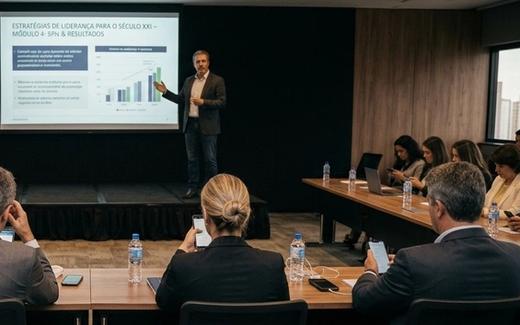
Training leaders at the speed of AI is now competitive survival
There is a silent cost running behind the balance sheets of mid-sized companies that few CFOs can spot on a spreadsheet, but every employee feels in their bones: the cost of unprepared leadership. In 2026, this cost is no longer merely a matter of culture or organisational climate. It has become a measurable business risk — and, in many cases, existential.

- The cost of unprepared leadership is now a measurable business risk
- Global engagement fell to 21% in 2024 (Gallup)
- 65% name their direct boss as the biggest source of stress (Hogan)
- Zero overlap between what executives show and what teams want
- 84% of training content is lost within three months
- NR-1 requires the management of psychosocial risks
There is a silent cost running behind the balance sheets of mid-sized companies that few CFOs can spot on a spreadsheet, but every employee feels in their bones: the cost of unprepared leadership. In 2026, this cost is no longer merely a matter of culture or organisational climate. It has become a measurable business risk — and, in many cases, existential.
In this article:
- What it is: diagnosis of the chasm between the competencies that executives demonstrate and those that employees actually need — with data from Gallup, Hogan Assessments and Deloitte.
- Why it matters: global engagement fell to 21% in 2024 (Gallup State of the Global Workplace 2025); 65% of employees consider their direct manager the greatest source of stress in their lives (Hogan Assessments, 2025, n=9,794, 25 countries).
- What to do: adopt validated assessments before promotion, measure development ROI with dashboards and replace one-off workshops with continuous, personalised mentoring.
Two recent global studies sound a red alert that HR leaders and CEOs must face with urgency. Gallup, in its State of the Global Workplace 2025, shows that global engagement has plummeted to 21%, a drop equivalent to that observed in the first year of the pandemic. The most troubling finding: this decline is driven largely by the disengagement of the very managers who oversee people.
Those who should sustain the team's momentum have paradoxically become the primary source of apathy. Meanwhile, the Hogan Assessments report, The Leadership Divide — based on responses from 9,794 employees across 25 countries and more than 21,000 executive assessments — reveals an even more disturbing conclusion: there is absolutely zero overlap between the five most-demonstrated competencies of current executives and the five competencies that employees say they want in their leaders.
Zero overlap. That is the size of the chasm separating those who decide from those who execute.
The problem in focus: we are promoting the wrong people
The Hogan research reveals that executives worldwide are recognised and promoted for inspiring others, competing, presenting ideas with confidence, taking initiative and driving innovation. They are, in essence, emerging leaders — people who stand out, sell their own image well, articulate vision. The problem is that teams want none of this. Employees want five entirely different things: effective communication, data-driven decision-making, accountability (being held responsible for results), integrity and genuine people leadership capability.
The difference is stark: 97% of global respondents consider effective communication as an important or extremely important characteristic in an ideal leader. Another 97% cite data-driven decision-making based on sound judgement. 97% want accountability. 97% expect integrity. And yet, none of these competencies feature at the top of the profile of leaders actually in power.
What does this mean in practice? It means that organisations are systematically confusing visibility with substance, performative confidence with real competence, self-promotion with the ability to build and sustain high-performance teams. And they pay a heavy price for this confusion.
The real cost: mental health, turnover and lost productivity
Hogan's most brutal finding: 65% of people state that the most stressful part of their lives is their direct manager. Not traffic, not household budget, not national politics. It is the leader they encounter every day in the 9 a.m. meeting. This has a technical name — psychosocial risk — and measurable consequences: anxiety, burnout, medical leave, productivity decline, and ultimately talent attrition.
NR-1 in response to work's impact on mental health
In Brazil, this scenario took on definitive regulatory contours with the update to NR-1, which now requires management of psychosocial risks in organisations. It is no longer merely a matter of 'culture'; it is now a matter of legal compliance. And the number-one generator of psychosocial risk in organisations, according to evidence accumulated over decades of research, is poor leadership.
Add to this what Hogan calls the dark side of personality: characteristics that emerge when the leader is under pressure. Current managers tend to be confident and assertive, but with moderate to high risk of appearing arrogant; charismatic, but prone to testing boundaries; expansive, but dramatic. 72% of employees worldwide say they do not want leaders with emotional volatility and unpredictability. 62% reject leaders with passive-aggressive behaviour. 59% reject arrogance. When these tendencies emerge — and they inevitably do under stress — teams lose trust, talent leaves, and performance plummets.
Deloitte studies show that 57% of organisations point to lack of alignment between current leadership capabilities and the company's strategic needs. Add to this a finding from ATD (Association for Talent Development): 50% of knowledge acquired in training is forgotten within five weeks, and 84% is lost within three months when there is no practical application. It is no wonder that the Center for Creative Leadership finds that 71% of traditional leadership development programmes simply cannot keep pace with market change velocity.
We are investing in leaders we no longer have time to develop using old methods.
The pressure of AI: accelerating results versus human drain
Meanwhile, artificial intelligence has transformed into a new benchmark for everything. Boards of directors demand productivity acceleration. Investors push for higher margins with smaller teams. CEOs must report weekly on how they are leveraging technology to do more with less. And middle managers find themselves caught in this pincer: they must deliver more, faster, with anxious teams worried about their own employability, in an environment where institutional trust crumbles and work no longer offers security or purpose.
It is precisely in this scenario that the quality of human leadership becomes the critical variable. When algorithms assume the operational work, competitive advantage shifts to what only people do well when good leadership is present: contextual judgement, ethical decisions, integration of diverse teams, care for mental health, building of purpose. Companies that only invest in AI but fail to prepare human leadership to guide this transition will have more productive teams in the short term and more fragile organisations in the medium term. It is the kind of efficiency that eats away at competitive advantage from within.
"There is no point in humanising relationships if it does not mean extracting the maximum potential from each person. But there is also no point in extracting performance by burning out people. The leader of the future is one who sustains both — and that is not learned in an eight-hour workshop."
— William Câmara, COO of Upskill Platform
Why Upskill bets on hybrid mentoring with humans and AI
With over 20 years mentoring C-level executives, presidents and founders of companies like Adobe, IQVIA, Mercado Bitcoin, Stefanini Cyber, Ingredion and ConectCar, an electrical engineer from PUC-SP, with an MBA in entrepreneurship and currently studying Artificial Intelligence at MIT — he has observed firsthand what he calls 'the waste curve'. It is the mental graph of every leadership development initiative that begins with euphoria, passes through an intense workshop, and dies in the three weeks that follow because the leader returns to their routine and has no one to turn to when the first real challenge arrives.
"Traditional training fails at an obvious point: it delivers content in a single moment and expects the leader to apply it alone", Will explains. "The human brain does not work that way. Behavioural skill is consolidated through repetition, on-demand support and real-time correction. This is precisely what generative AI has made possible to do at scale for the first time."
Upskill's central thesis is that leadership development must be, simultaneously, three things: personalised, continuous and measurable. Personalised because each leader has a profile, specific skill gaps and a unique business context. Continuous because behaviour changes day to day, not on retreats. Measurable because what is not measured does not receive sustained investment — and HR needs to demonstrate ROI to sustain budget.
How hybrid mentoring works in practice
At Upskill, each leader begins with an assessment that maps their leadership profile and skill gaps. A proprietary algorithm, fed by over two decades of mentoring expertise, suggests customised learning paths and performs Mentor Match — a semi-automated selection that pairs the leader with the mentor most suited to their moment, with final curation done by an experienced specialist.
From there, the leader engages in live one-on-one mentoring sessions with certified human mentors and simultaneously has 24/7 access to mentorIA — a virtualised mentor trained weekly with the company's proprietary methodology and the experience of its own mentors. When the leader leaves a human session with a 'mission' to apply during the week and encounters a difficulty at 10 p.m. on a Tuesday, they do not need to wait for the next session to get help: mentorIA is there, with context, tools and the methodology frameworks.
The human transforms, the AI sustains and amplifies. This is the equation that changes the game of learning retention: instead of losing 84% of content within three months, the leader consolidates competence because they have continuous reinforcement. Meanwhile, the platform measures — engagement, progress by skill, most recurring themes, performance impact — delivering to the talent manager a dashboard that allows real ROI calculation.
What Ryerson University's study suggests
An exploratory study conducted by researchers at Ryerson University (now Toronto Metropolitan) in Toronto, with interviews and a survey of 77 practitioners, using instruments such as the Mindful Attention Awareness Scale and the Dispositional Resiliency Scale, documented consistent reports of increased self-awareness, resilience, focus, self-control, productivity, physical and mental wellbeing, and self-confidence in participating leaders. Most importantly: the study identified the mechanisms that actually drive behaviour change — clarity of objectives, positive connection with the mentor, confidence in results demonstrated through data, and practical, applicable learning.
It is no coincidence that these are precisely the mechanisms absent from traditional training.
The price of not acting: a calculation for CEOs and HR leaders
Consider a mid-sized company with 50 leaders. Imagine that 30% of them currently generate what Hogan calls derailers — behaviours that undermine team trust. Each of these leaders impacts, on average, a team of 8 people. We are talking about 120 employees at elevated psychosocial risk, with engagement below the global average of 21% and turnover well above healthy levels.
The cost of replacing a qualified employee ranges from 50% to 200% of annual salary, according to SHRM studies. Add to this the productivity decline of those who remain, medical leave due to mental health — now monitored by NR-1 — the reputational damage as an employer, and talent flight to competitors. The annual hidden cost of maintaining unprepared leaders in a company of this size easily exceeds millions.
Compare this to the cost of a continuous hybrid mentoring programme — a fraction of that value, with measurable return in individual performance, retention and culture indicators.
The choice is not between investing and not investing. It is between investing in an agile, measurable solution now, or paying the — far higher — bill in compromised organisational health, lost talent and eroded competitive advantage.
What CEOs and HR leaders need to do now
First: stop promoting by visibility. Hogan's data is clear. Those who shine in executive committee presentations are not necessarily those who build high-performance teams. Adopt validated personality and values assessments before promotion. Include behavioural interviews that reveal accountability, integrity and genuine people leadership capability, not just 'presence'.
Second: redefine what high potential means. High potential is not who sells themselves best. It is who combines technical competence with humility, openness to feedback, sound judgement and the ability to build trust. This can be measured.
Third: abandon the disposable training cycle. One-off workshops and canned courses have 84% of content lost within three months. In a scenario where AI accelerates all business cycles, this waste is a flawed strategic decision. Adopt continuous, personalised and measurable programmes.
Fourth: use the right technology to scale humanity, not replace it. AI applied to leadership development is not a chatbot that answers questions. It is a virtualised mentor trained in proprietary methodology, who sustains learning between sessions with human mentors, personalises paths and generates progress data. This is what moves development from paper into real behaviour.
Leadership is the lever, not the ornament
In a BANI world — fragile, anxious, non-linear and incomprehensible, as the Edelman Trust Barometer 2026 described — institutions lose credibility and people turn to smaller circles. Curiously, it is precisely the employer who still holds some trust with the employee. This places enormous responsibility in the hands of organisations: the opportunity to rebuild trust from within, starting with leaders.
Upskill was born from the conviction that this reconstruction is not a luxury, but the primary lever for results, culture and sustainable transformation that exists today. There is no AI tool, lean process or market strategy that survives leadership that harms people. And there is no time, at the current pace, to develop leaders the old way.
The question that matters to each CEO and HR leader at this moment is straightforward: what does your next quarter of unprepared leadership cost — and what would it be worth to start changing that scenario, today, at the speed this world demands?
If you want to understand how to accelerate and measure your leadership development, schedule a free diagnosis via contact@upskillplatform.com.
Mentors and specialists in leadership development, with more than 20 years of practice mentoring executives and entrepreneurs.