Assessing behaviour is not the same as changing behaviour
You might be confusing the role of an HR and L&D platform with the role of a leadership development platform. This confusion is common — and it makes sense that it exists. And I want to use this space to clarify the difference between them and show you that measurement is necessary, but not sufficient when it comes to developing people to drive results.
- The difference between an HR and payroll platform and a leadership development platform
- What HR platforms do well: rituals, data and centralising the people process
- Why measuring accurately does not change the manager's behaviour on Monday
- The numbers on training as an event: Saks & Belcourt (2006) and the CEB's scrap learning
- Upskill's three stages: diagnostic, development and measurement
- Where the two systems complement each other — the data points, the mentoring executes
You might be confusing the role of an HR and L&D platform with the role of a leadership development platform. This confusion is common — and it makes sense that it exists. That's why I want to use this space to clarify the difference between them. Moreover, I intend to show you that measurement is necessary, but not sufficient when it comes to developing people to generate results.
What an HR and L&D platform does very well
I'll start with what these tools do well, because I have no interest in dismissing what's working in your organisation.
Feedz, Qulture.Rocks, Solides, Gupy, Lattice, Culture Amp — all these platforms are people process infrastructure. They organise and scale HR rituals: evaluation cycles, continuous feedback, recorded individual development plans, climate surveys, OKRs, recognition, onboarding, centralised records, people analytics.
Before that, everything was done in spreadsheets. Anyone who's tried to run a 300-person evaluation cycle in Excel knows how much gain there is in automating with platforms built for this. It's a real leap in maturity and, moreover, it has significant value for anyone who will mentor a leader from that organisation.
When I speak of platform, some HR professionals, or even development professionals, already think of HR and L&D processes, or even platforms with pre-recorded content.
So, I felt the need to clarify more directly: at Upskill Platform, we don't do payroll. We don't do hiring. Or timesheets. And we don't do corporate climate surveys. We don't replace your performance evaluation cycle. If your pain is organising people processes, the answer isn't Upskill — it's a good HR platform, and there are several.
What they weren't built to do
An HR platform tells you that there is a problem. It doesn't tell you how a specific leader, with a specific story, in a specific context, will change their behaviour.
Let me be more direct.
A climate survey, for example, might reveal that the operations manager's team has the lowest trust index in the company's leadership. The system shows this with surgical precision, in red, on the heat map. HR takes it to the committee. Everyone agrees it's serious.
And then?
The following Monday, that manager is still exactly the same manager. Same reactions, same way of giving difficult feedback, same decision-making pattern under pressure. Although the assessment was accurate, the behaviour didn't change.
The individual development plan is the most glaring example of this. The leader fills it out. And it's the leader who executes it. But who sustains that execution over months? No one. The field gets filled in, the cycle closes, the report goes out — and behaviour stays the same.
I'm an engineer, so forgive the obvious analogy: the car dashboard tells you the temperature has gone up. It doesn't fix the engine. No dashboard in the world has ever fixed an engine. And no one changes their dashboard when they discover the problem is with the belt.
"Then I'll hire a training programme"
That's the second answer that always comes up. Identify the gap, put a course on the track, done.
Only the numbers don't back up that bet. A study published in Human Resource Management (Saks & Belcourt, 2006) with 150 organisations showed that training application at work drops from 62% immediately after the course to 34% one year later. The CEB (now Gartner) estimates that 45% of all training investment becomes 'scrap learning' — content delivered that is never applied. And the most robust meta-analysis on the subject (Blume et al., 2010) identifies the key factor that separates those who apply from those who forget: continuous support after training.
The reason is simple and nobody likes to hear it: a course is an event. Leadership behaviour doesn't change with events, with one-off access to content — and without support. It changes through repetition with support.
It's training, not a class. The leader learns a tool on Thursday, tries to apply it on Tuesday, gets stuck in the middle — and that's exactly at that moment that they need someone. If there's no one, they abandon the tool and revert to old behaviour. Then the investment becomes a cost.
We need to remember that there's competition between productive time and time spent on training and learning, and the leader is being pressured daily to generate quick results. So, if they try to implement knowledge from the last course they attended, and it doesn't produce the expected effect, they simply abandon it.
More than a platform
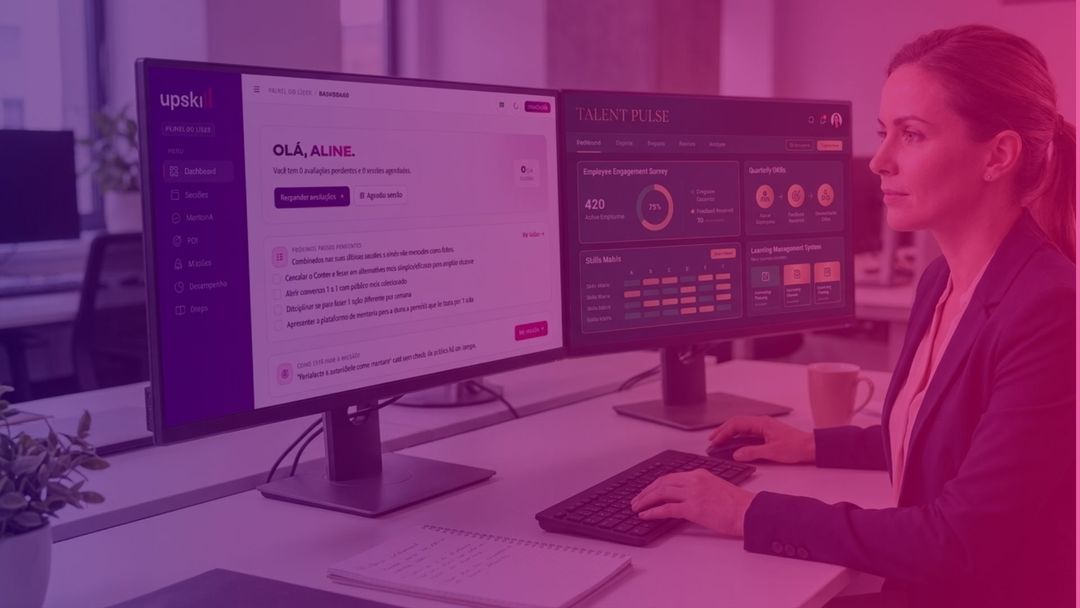
Upskill Platform is a leadership behaviour transformation system. One-to-one mentoring with human mentors and an AI-powered virtualised mentor with data science, operating in three stages:
1. Diagnosis
Each leader takes an assessment that identifies their current leadership profile and skill gaps within that profile. This runs on a proprietary algorithm built from the experience of hundreds of mentors developing leaders and studying behaviour for over 20 years.
2. Development
An algorithm identifies the mentor with the greatest affinity for that leader, and a specialist makes the final curated selection. From there: individual mentoring sessions, group mentoring, and mentorIA (our AI-powered virtualised mentor) available 24/7, with access to the full toolkit of our methodology.
3. Measurement
Engagement, individual and group progress, most common leadership themes, and data needed to calculate ROI. HR stops defending budgets by saying 'people liked it' and starts defending with evidence of progress.
But if I had to point out where the real value lies, I'd say it's in what happens between sessions with human mentors.
The leader leaves mentoring with a mission to apply in their routine. On Wednesday, they get stuck in a difficult conversation with a team member. At the end of the day, they consult mentorIA, understand what they did, adjust, try again on Thursday. Week after week, this hones the skill until it's consolidated.
It's this continuous support that breaks Ebbinghaus's forgetting curve.
And, to be explicit: it's not an LMS, it's not one-off consulting, it's not ad-hoc coaching.
The most fundamental differences
| HR Platform | Upskill Platform | |
|---|---|---|
| Question it answers | What's happening with our people? | How does this leader change, in practice? |
| Nature | System for recording and identifying problems | Behaviour transformation system |
| Scope | All employees, complete journey | Leadership and potential leaders |
| Delivery | Data, rituals, centralisation | Sustained behaviour change |
| Who executes and manages | HR and managers, with existing knowledge | Human mentor + mentorIA + Customer Success + HR |
| And the individual development plan? | Records the plan | Executes and sustains the plan |
Where the two systems complement each other
Now the part that really matters, because in practice they don't compete — they complement each other.
Your HR platform identifies
Climate, 9-box, performance reviews and eNPS reveal where leadership is costly: turnover concentrated in specific teams, low engagement under certain managers, empty succession pipeline.
Upskill enters where the data stops
We take the priority leaders that diagnosis revealed, deepen the behavioural mapping, and design each leader's individual journey.
The individual development plan stops being just a completed field
The plan living in your system now has real execution: mentor assigned, tools in hand, weekly mission, support when things stall.
And the data comes back
Progress measured on our platform feeds into the next evaluation cycle and succession conversation. The cycle closes, and closes with evidence.
Your HR platform is the diagnosis of where the most critical business pain points are when it comes to people. Upskill is the solution for pain points that stem from leadership behaviour.
Three questions to test yourself
- Can you identify right now the three critical behavioural gaps in your 10 most important team leaders? Or do you only know that climate worsened in some teams?
- Of the individual development plans completed in your last cycle, what percentage were actually executed through to the end?
- If I ask how much your company invested in leadership development over the last 12 months and how much that moved the needle on performance, do you have the number — or just a perception?
If all three answers bothered you, the problem isn't with your HR platform. It's in integrating it with a system that supports the leadership behaviour change process.
Leadership is your greatest lever for results
Over 20 years developing leaders, and I remain convinced: leadership is the greatest lever for results within any organisation. No other variable moves performance, culture and retention as much.
And it won't be resolved with another report or assessment.
If you want to understand where your organisation stands and whether we can help you drive behaviour and results, let's talk. I want to help you gain clarity on where the bottleneck is so leadership can transform results through people.
Mentors and specialists in leadership development, with more than 20 years of practice mentoring executives and entrepreneurs.