How to trust the content shared in 1:1 mentoring for middle management?
What do mentors share with your company's leadership during 1:1 mentoring sessions? This is a common question among HR professionals or Executive Directors from companies that hire Upskill's individual mentoring programmes for middle management. And I understand why this doubt is so recurrent and so critical. It's precisely because I understand that I've decided to clarify which pillars we use to build this trust.
- The paradox: 1:1 mentoring accelerates middle leadership but unsettles the board
- Why recorded or group training feels safe and fails at changing behaviour
- Ebbinghaus's forgetting curve, confirmed by Murre and Dros (2015)
- What a good mentor shares: reflection, practical tools and lived experience
- 4 pillars that give HR visibility without breaking the leader's confidentiality
- The human + mentorIA pair: the human transforms, the AI sustains between sessions
What do mentors share with your company's leadership during 1:1 mentoring sessions?
This is a common question among HR professionals or Executive Directors from companies that hire Upskill's individual mentoring programmes for middle management.
And I understand why this doubt is so recurrent and so critical. It's precisely because I understand that I've decided to clarify which pillars we use to build this trust.
After all, every company today has the need to accelerate the development of its leaders so they continue generating results, driving transformations, without harming people.
And what I see in our clients is that scaling leadership mentoring to middle managers has been a critical factor in sustaining a healthy environment and competitive advantage in today's scenario.
And then we see a paradox: 1:1 mentoring accelerates the maturity gains of middle management but, on the other hand, creates discomfort in the board, which doubts whether the individual mentoring content will generate return for the business.
Throughout this article, I want to clarify which pillars create trust in this process.
The shortcut that feels safe (and why it fails)
To feel in control, many managers end up opting for recorded or group training. The logic is simple: "If I can watch the content, I know what type of content my leaders have access to."
The problem is that knowing the shared content doesn't guarantee leader engagement, or even a post-training behaviour change that positively impacts daily work.
Hermann Ebbinghaus's study of the forgetting curve, still current, shows why: without reinforcement or practical application, employees forget up to 90% of training content in up to 30 days. This has already been reaffirmed by a study by researchers from the University of Amsterdam, Jaap Murre and Joeri Dros.
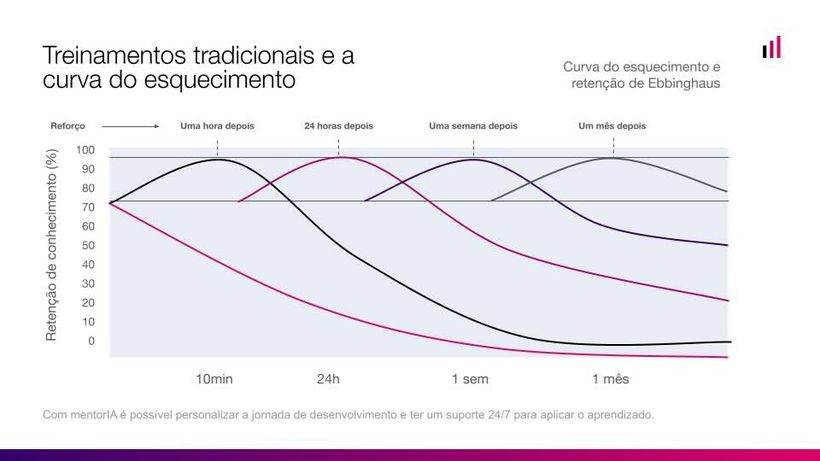
Confirmation of Ebbinghaus's theory
Murre and Dros (2015) replicated Ebbinghaus's forgetting curve and confirmed the sharp drop in retention within the first hours after learning. The mechanism behind this is described by Hardt, Nader and Nadel (2013): forgetting is an active process of synaptic weakening (LTD), in which the brain dismantles underused connections to optimise its efficiency. Reinforcing and applying learning signals that the connection has value — and that's what stops this dismantling.
And why is content from group or recorded training likely to be forgotten? Because there's a lack of alignment or opportunity to apply the content, or lack of support for implementing the learning in the leader's daily work.
Forgetting tends to be further aggravated by factors such as sleep deprivation, stress or the presence of new information, common in a leader's work routine in today's scenario.
But the quietest gap isn't forgetting. It's another:
A leader's greatest challenges are almost never within the topics he feels comfortable raising in front of the group. And in recorded training, this questioning opportunity doesn't even exist.
A leader won't admit, in a workshop with peers and the boss in the room, that he's insecure about giving difficult feedback, that he's lost control of the agenda, that he fears losing a key talent from the team, or that he's exhausted and doesn't know how to sustain the pace. These are exactly the topics that block performance — and that the leader avoids addressing in front of the team or colleagues.
That is: group training for middle management and employees in general is comfortable for HR and senior leadership because it's visible, but it becomes inefficient at changing behaviour because it's exactly where the leader keeps most guarded. And behaviour that doesn't change doesn't generate change in business results.
On the other hand, 1:1 mentoring is where behaviour truly changes — because it's the only space where the leader drops his guard. But it's confidential. And there we're back to the director's pain.
The right question, then, isn't "how do we open up confidentiality?". It's "how do we trust what happens within it without breaking it?"
What a good mentor really shares in the session
Before solving the pain, it's worth busting a myth. The image many people have of mentoring is an expert "dumping" generic advice. That's not how a programme that changes behaviour works.
In practice, the model doesn't start with the mentor speaking. It starts with listening. An in-depth diagnosis of each participant's leadership profiles, the skills gaps mapped in the assessment and the business objectives that HR defines. In addition, the contextualisation of the programme and the virtualised mentor with AI is done with the organisational culture, each leader's individual development plan, and the current business objectives most impacted by middle management's performance.
The session starts from where that leader is — not from a ready-made slide.
An experienced mentor (human or virtualised by AI) essentially shares three things:
- Reflection on behaviour — provocations about habits and attitudes blocking the leader's performance and wellbeing.
- Practical tools — a toolkit applicable to that leader's real and current challenge, not shelf-ready theory.
- Lived experience — our mentors have 10 to 20 years developing executives and entrepreneurs. They're not academics or generic facilitators; they've lived the challenges your leadership faces.
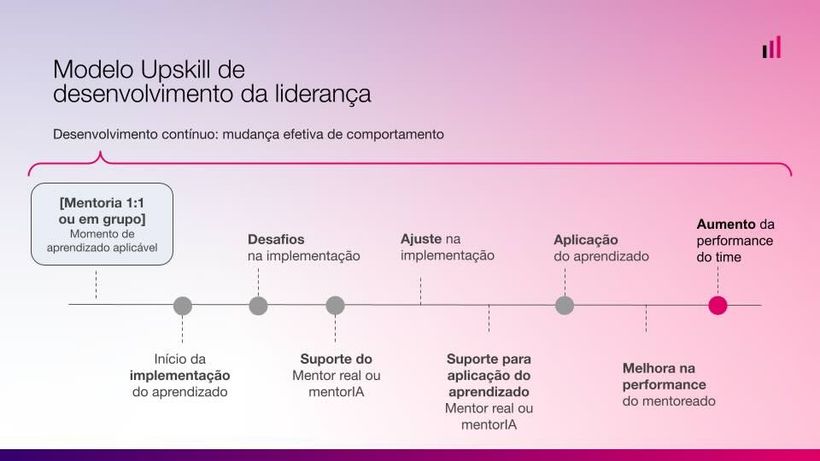
What comes out of the session (with a human, or with the mentor virtualised by AI) is always the same thing: a practical mission to apply in daily work. It's the application — reinforced between meetings — that consolidates learning.
How Upskill returns security to HR — without breaking the leader's confidentiality
Here's the central point: the privacy of content and the visibility of progress are not enemies. You can have both at the same time. That's what the platform was built to deliver.
4 pillars that guarantee visibility without breaking confidentiality
1. You know the mentors deeply — before any session
We send clients detailed information about each mentor: background, experience and areas of expertise. And the choice of who sees each leader isn't random: an algorithm (Mentor Match) selects the mentors most compatible with each mentee's profile and challenge, and a human specialist validates that choice before it starts.
2. All mentors are certified in our proprietary methodology
This means that, although each conversation is unique, they all follow the same method validated by over two decades of practice — and endorsed by academic study (Ryerson University, Toronto). The session becomes more objective and the result more predictable. Additionally, mentors undergo weekly training with new cases and tools, ensuring that the toolkit reaching the leader is always up to date.
3. You see the most discussed topics — without entering confidential content
The dashboard shows which topics were most worked on in sessions, individually and collectively. You identify recurrent challenges affecting most of your leadership, without ever accessing what was privately said (a commitment formalised publicly in the Trust Center). It's the visibility you need, at the right level.
4. Periodic assessments and development plan per leader
Each leader has a development plan assigned at the beginning of the programme, and periodic progress evaluations allow the development manager and senior leadership to track each one's advancement — and calculate the ROI of investing in the programme.
The result: HR tracks quality, topics and progress in real time. What stays protected is only the intimate content of the conversation — which is exactly what needs to stay protected for the leader to be honest about his most critical challenges.
And the leader? Gains the space the group never gave
On the mentee side, confidentiality isn't a legal detail — it's the condition for the programme to work. It's where the leader feels comfortable bringing the pain he would never put in front of peers or senior leadership.
And that's where the human pair + AI comes in:
- The human mentor transforms: creates the connection, provokes deep reflection and delivers the most assertive tool for that leader's most current daily challenge.
- The mentorIA sustains: human sessions remain private, but mentorIA has access to the structured records of each session. With this, it supports the leader between sessions, reinforces the behaviour worked on and keeps the change plan active — 24 hours a day, 7 days a week. The human transforms. Customer data is not used to train AI models – as per the Responsible AI Policy published in the Trust Center.
"Selecting the mentor for each leader was key to extracting the most current needs from each person's journey and acting to bring solutions to the most relevant problems at the moment." — Lillian, former HR manager at Devio
In summary
The insecurity in hiring confidential mentoring is real — but it stems from a false choice between "trusting" and "having visibility". You don't have to give up one to have the other.
With certified mentors presented in detail, topics monitored in the dashboard, development plan per leader and periodic assessments, HR and the board gain predictability. AI sustains and amplifies. And at the same time, the leader gains the only place where he speaks about what really matters — which is, in the end, where behaviour changes and business results move.
Want to see how this works in practice, with your context?
Schedule a demo.
Mentors and specialists in leadership development, with more than 20 years of practice mentoring executives and entrepreneurs.